Quick Answer
Dada and Surrealism are linked but distinct. Dada (from 1916) was an anti-art protest built on chaos, chance and absurdity, while Surrealism (from 1924) grew out of it and turned inward to explore dreams, the unconscious and desire.
In This Article
- The Revolutionary Currents: Introduction to Dadaism and Surrealism
- The Deliberate Chaos: Understanding Dadaism
- The Dream World Manifested: Exploring Surrealism
- Bridging Movements: The Transition from Dada to Surrealism
- Defining Differences: Dadaism versus Surrealism
- Revolutionary Methods: Key Works and Techniques
- Beyond Visual Art: The Literary Dimension
- Political Dimensions: Art as Resistance and Revolution
- Global Movements: Geographic Variations and International Spread
- Influence on Contemporary Art
- Dadaism And Surrealism Movements
The Revolutionary Currents: Introduction to Dadaism and Surrealism
Dadaism and Surrealism Movements stand as two of the most influential artistic movements of the early 20th century, reshaping not only the world of visual art but extending their impact deep into literature, film, philosophy, and cultural discourse. These avant-garde movements emerged from the turmoil of World War I and its aftermath, reflecting the profound psychological and societal disruptions of their time.
Origins in Chaos and Dreams
Born in the neutral territory of Switzerland during the devastation of the First World War, Dadaism erupted as a provocative artistic rebellion against rationality and the cultural values that many artists believed had led Europe into catastrophic conflict. Surrealism, while inheriting many of Dada’s revolutionary attitudes, evolved into a more structured movement with specific philosophical underpinnings, particularly informed by Freudian psychoanalysis and an exploration of the unconscious mind.
Artistic Innovation and Psychological Depth
Artists from both movements produced works of startling originality and psychological depth, challenging conventional aesthetic standards and expanding the very definition of what art could be. Their radical approaches to creation—embracing chance, the irrational, dreams, and the subconscious—established new pathways for artistic expression that would influence generations to come.
Connected yet Distinct Philosophies
While there exists a direct historical connection between these movements—with many prominent Dadaists later joining the Surrealist ranks—they represent distinct artistic philosophies and responses to their cultural contexts. Dadaism embraced nihilistic negation and anti-art provocation, while Surrealism sought to reconcile dreams and reality into a new, expanded consciousness. Together, they laid crucial foundations for modernism and postmodernism, their influence resonating through contemporary art practices even today.
Enduring Legacy
These movements didn’t merely change how art was made—they transformed how we understand the relationship between art, society, psychology, and political resistance. Their legacy continues to inspire artists seeking to challenge conventions and explore the deeper realms of human experience.
The Deliberate Chaos: Understanding Dadaism
Dadaism (1916-1924) emerged as a spontaneous reaction of artists to the horrors of World War I. Far from being a conventional art movement, it represented a deliberate defiance of established artistic norms and cultural values. Born in the neutral territory of Zurich at the Cabaret Voltaire, Dada arose as artists sought to express their disgust with the rationality that had led Europe into unprecedented destruction.
The Revolution of Chance and Randomness
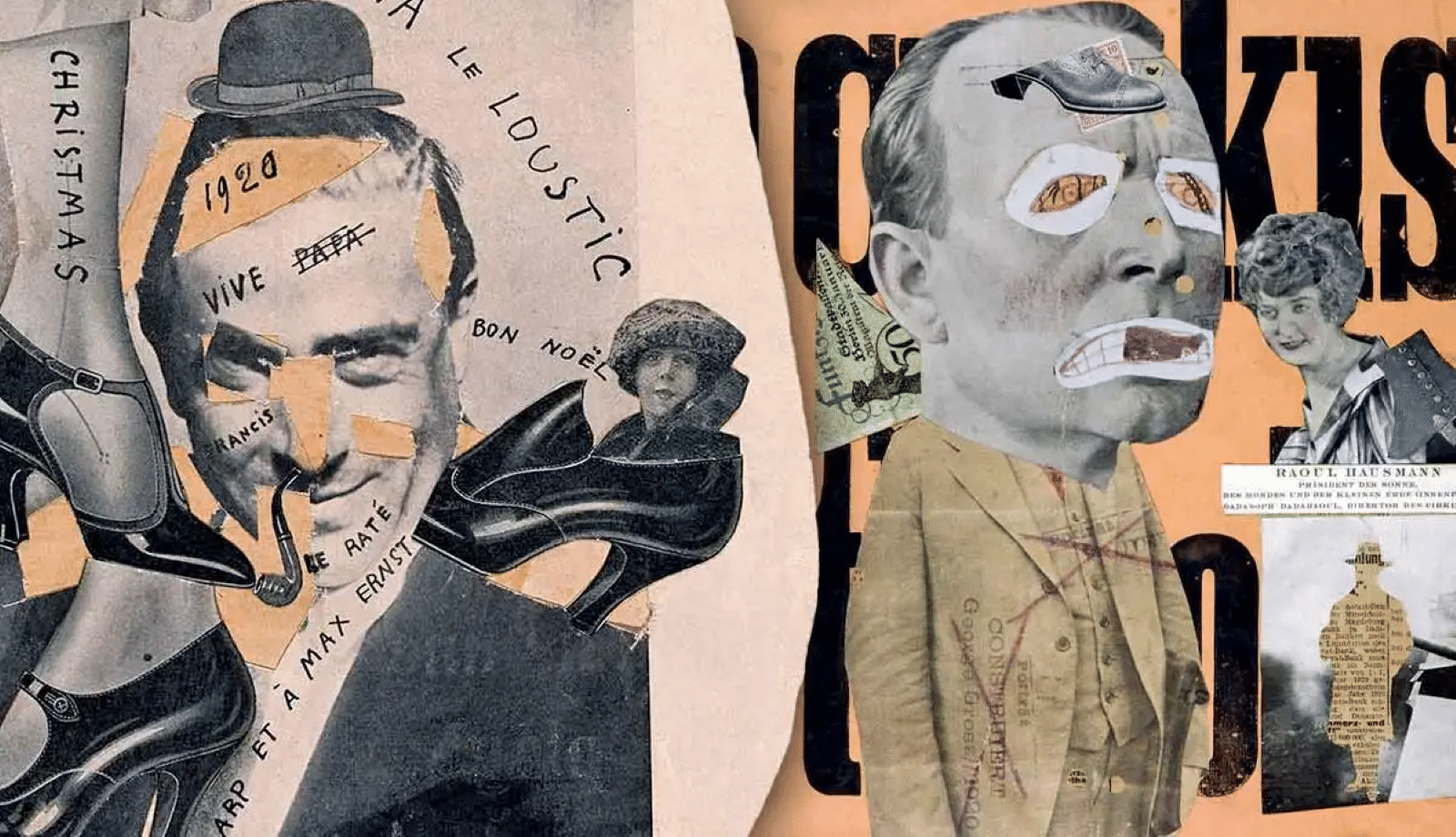
Dada artists revolutionized creative practice by embracing the concept of ‘chance’ as the foundation of their artistic expression. They deliberately subverted traditional artistic techniques, working with manufactured items, magazine pictures, scissors, and glue rather than traditional paints and canvases. In this way, they directly challenged the very definition of art by rejecting its established principles and materials.
The Anti-Art Movement
Dadaism was famously characterized as anti-art because it fundamentally rejected the idea that art should make aesthetic or logical sense. The movement embraced the nonsensical, the random, and the deliberately absurd as appropriate responses to a world gone mad. If societies could justify the mechanized slaughter of millions, Dadaists argued, then conventional definitions of meaning, beauty, and art deserved to be dismantled.
The movement’s provocative stance suggested that if war could be justified as rational, then anything could be considered art—even a toilet seat displayed as sculpture. Marcel Duchamp’s “readymades,” particularly his 1917 work “Fountain” (a urinal signed with the pseudonym “R. Mutt”), embodied this challenge to artistic conventions and earned him iconic status as a Dada exponent.
International Impact and Expression
Dada was truly international in scope, with significant centers developing in Romania, Germany, Switzerland, and the United States. Each regional manifestation developed its own characteristics while maintaining the movement’s core spirit of rebellion. In Berlin, Dada took on a more politically charged character, while New York Dada, influenced by Duchamp and Man Ray, explored the boundaries between art and everyday life.
The Philosophy of Meaningful Meaninglessness
At its philosophical core, Dadaism advocated for people to forget everything they thought they knew and to embrace living according to chance and intuition. The movement’s artistic tenets were deliberately based on having no fixed truths, beliefs, or rules. Dadaism was about twisting reality, operating outside the mainstream, and finding meaning in apparent meaninglessness.
Despite its brief formal existence, Dadaism’s revolutionary approaches—embracing meaninglessness, absurdity, and chance—profoundly influenced subsequent artistic developments. By dismantling conventional artistic values and embracing creative freedom at all costs, the movement established crucial precedents for artistic expression throughout the 20th century and beyond.

The Dream World Manifested: Exploring Surrealism
Surrealism emerged in the early 1920s, chronologically following Dadaism without significant temporal interruption, yet representing a distinct artistic and philosophical approach. While both movements were born from the disillusionment of World War I, Surrealism developed a more structured framework and specific creative mission under the leadership of André Breton, who published the first Surrealist Manifesto in 1924.
Beyond Rebellion: Structured Exploration of the Unconscious
Unlike Dadaism’s deliberate mockery of rules and embrace of meaninglessness, Surrealism sought to forge a meaningful bridge between the subconscious mind and external reality. Surrealists were not anti-art rebels but explorers of hidden mental territories, seeking to access and express deeper psychic truths that lay beneath rational consciousness.
The movement never embraced the anti-art stance that characterized Dadaism, nor did its notion of artistic autonomy embody the same meaning as Dadaism’s devotion to chance operations. Instead, Surrealists developed specific techniques and approaches to access what they believed were authentic expressions of the unconscious mind.
The Freudian Foundation
Surrealism was profoundly influenced by the psychoanalytic theories of Sigmund Freud, particularly his work on dream interpretation and the unconscious mind. This theoretical grounding—largely absent from Dadaism—provided Surrealists with both intellectual framework and practical techniques for their artistic explorations.
The movement embraced dreams as privileged windows into the unconscious, viewing them as revelatory experiences that could expose desires, fears, and truths obscured by rational waking life. Through their art, Surrealists attempted to capture the logic-defying juxtapositions, transformations, and emotional intensities characteristic of dream states.
Methodologies of the Subconscious
Surrealism developed specific techniques designed to bypass rational thought and access unconscious material. Automatic drawing and writing—creating without conscious planning or revision—became foundational practices. These approaches functioned as forms of artistic psychoanalysis, allowing for free association and the emergence of unexpected imagery and connections.
The movement’s experimental methods sought a deeper understanding of subconscious processes and dream mechanics. Artists developed ways to induce and record trance-like states, collective creative sessions, and games designed to reveal unconscious patterns and associations.
The Dreamlike Aesthetic
The visual language of Surrealism is distinctively dreamlike—familiar elements combined in impossible ways, distortions of scale and perspective, and atmospheric qualities that evoke psychological states rather than physical realities. Surrealist works often seem to exist in a void beyond ordinary time and space, possessing the uncanny quality of being both familiar and utterly strange.
Masters of the movement like Salvador Dalí and Giorgio de Chirico created meticulously rendered dreamscapes that posed profound questions: Can you hear the silence of empty space? Can you interact with an atmosphere that feels both inviting and alienating? Can the inner landscape of dreams be mapped in visual form?
Unlike the often deliberately crude or provocative work of Dadaists, Surrealist art frequently displayed remarkable technical skill, using refined techniques to render impossible scenes with photographic precision. This combination of technical mastery and dreamlike content created the movement’s distinctive tension between the real and the unreal.
Enduring Psychological Inquiry
Surrealism’s focus on psychological exploration rather than mere aesthetic rebellion has given it remarkable staying power in artistic and cultural discourse. Its techniques for accessing the unconscious mind continue to influence artists, writers, filmmakers, and even therapeutic practices nearly a century after the movement’s inception.
By creating a visual language for the inner workings of the mind, Surrealism offered new ways of understanding human psychology and experience. Its legacy lives on not only in art that depicts the bizarre and dreamlike, but in any creative work that seeks to transcend rational boundaries and access deeper currents of meaning and consciousness.
Bridging Movements: The Transition from Dada to Surrealism
The relationship between Dadaism and Surrealism is complex, marked by both continuity and significant philosophical divergence. Many prominent Dadaists eventually converted to Surrealism, creating a lineage of artists whose work evolved alongside these shifting artistic paradigms.
Timeline as a Distinguishing Factor
For art historians and enthusiasts, the timeline of creation often serves as a crucial differentiating factor when categorizing ambiguous works. Generally, if a piece exhibits characteristics of both movements but was created after 1926, it is more likely to be classified as Surrealist rather than Dadaist. This chronological approach acknowledges the historical evolution from one movement to the next.
Artists like Max Ernst, Man Ray, and Francis Picabia, who participated in both movements, demonstrate this transition in their evolving artistic practices. Their earlier works often embody Dadaist principles of chance and absurdity, while their later creations show the more structured dream exploration characteristic of Surrealism.
Defining Differences: Dadaism versus Surrealism
Though chronologically connected and sharing some practitioners, Dadaism and Surrealism represent fundamentally different approaches to artistic creation and philosophical inquiry.
Contrasting Philosophical Foundations
Dadaism’s radical stance embraced a philosophy of no philosophy—rejecting the very notion of coherent beliefs, transcendent truths, or governing rules. The movement was fundamentally about demolishing the boundaries of art and celebrating meaninglessness as a response to societal chaos. Its anarchic spirit found perfect expression in Marcel Duchamp’s provocative readymades, particularly his notorious urinal (“Fountain”) that challenged every conventional definition of art.
Surrealism, by contrast, embarked on a more structured artistic expedition into the realms of the subconscious, the unconscious, perceived reality, and the unseen bridges connecting these domains. Rather than rejecting meaning, Surrealists sought deeper forms of meaning beneath the surface of rational thought. This exploratory approach found powerful expression in the dream-inspired imagery of Salvador Dalí and Luis Buñuel’s groundbreaking film “Un Chien Andalou,” which translated dreamlike logic into visceral visual experience.
Intellectual Influences and Approaches
While Dadaism drew strength from anti-art sentiments, dry humor, absurdity, and chance operations, Surrealism built its foundation on the psychoanalytic theories of Sigmund Freud, particularly his work on the unconscious mind and dream interpretation. This theoretical grounding gave Surrealism a more cohesive intellectual framework than the deliberately incoherent Dadaist approach.
Legacy and Influence
Both movements profoundly influenced subsequent developments in art, culture, literature, and philosophy throughout the 20th century and beyond. From Dadaism emerged conceptual art’s emphasis on idea over execution, performance art’s provocative stance, and the readymade as a legitimate artistic strategy. Surrealism’s influence extends through psychological approaches to creativity, dream-inspired visual languages in film and advertising, and therapeutic techniques that access unconscious material.
Together, these revolutionary movements challenged conventional understanding of creativity and consciousness, expanding the boundaries of what art could be and how it could function in society. Their impact continues to resonate in contemporary artistic practices that question reality, explore psychological landscapes, and challenge established cultural norms.
Revolutionary Methods: Key Works and Techniques
Both Dadaism and Surrealism pioneered revolutionary artistic techniques that would transform the landscape of 20th-century art. Beyond their philosophical positions, these movements developed specific practical approaches that enabled artists to achieve their conceptual goals.
Dadaist Innovation and Iconic Works
While Marcel Duchamp’s “Fountain” (1917) remains perhaps the most notorious Dadaist creation, the movement produced numerous other groundbreaking works that challenged conventional understandings of art. Duchamp’s other readymades—including “Bicycle Wheel” (1913) and “L.H.O.O.Q.” (1919), a postcard reproduction of the Mona Lisa defaced with a mustache and goatee—similarly questioned artistic authority and authenticity.
Hannah Höch’s photomontage “Cut with the Kitchen Knife through the Last Weimar Beer-Belly Cultural Epoch in Germany” (1919-20) exemplifies the Berlin Dadaists’ political approach, combining mass media imagery into fragmented, chaotic compositions that critiqued German society and gender roles. Raoul Hausmann’s “Mechanical Head (The Spirit of Our Time)” (1920), an assemblage featuring a wooden mannequin head with various measuring devices attached, powerfully expressed the movement’s critique of rationality.
The technique of photomontage—cutting and reassembling photographs and printed material—became central to Dadaist practice, particularly in Berlin. Artists like Höch, Hausmann, and John Heartfield developed this approach as both an artistic strategy and political weapon, creating jarring juxtapositions that revealed hidden truths about society.
Kurt Schwitters’ “Merz” constructions—collages and assemblages built from urban debris, tickets, and discarded materials—created a new form of environmental art that transformed trash into complex aesthetic compositions. His “Merzbau,” begun in 1923, expanded this approach into architecture, creating an ever-growing sculptural environment in his home.
Surrealist Techniques and Masterworks
Surrealists developed specific techniques designed to access unconscious content. Max Ernst pioneered frottage (rubbing pencil or charcoal over paper placed on textured surfaces) and grattage (scraping paint across canvas laid atop objects), using chance-generated textures as starting points for hallucinatory imagery in works like “Forest and Dove” (1927).
Decalcomania, perfected by Oscar Domínguez, involved pressing paint between surfaces and pulling them apart to create unpredictable, organic patterns that suggested landscapes, creatures, or geological formations. André Masson employed automatic drawing—allowing the hand to move without conscious control—to produce works like “Automatic Drawing” (1924) that revealed surprising unconscious imagery.
Salvador Dalí’s “The Persistence of Memory” (1931), with its melting watches draped over barren landscape elements, exemplifies the dreamlike precision of what Dalí termed “critical paranoia”—using technically meticulous painting to render irrational scenes with photographic clarity. René Magritte’s “The Treachery of Images” (1929), featuring a pipe above the text “Ceci n’est pas une pipe” (“This is not a pipe”), questioned the relationship between representation and reality in a different way, using conceptual paradox rather than dream imagery.
The “Exquisite Corpse” technique—a collaborative game where artists created sections of a figure without seeing others’ contributions—became a crucial Surrealist method for bypassing rational control. The resulting bizarre composite figures revealed unexpected connections and embodied the group’s belief in collective unconscious processes.
Beyond Visual Art: The Literary Dimension
Both Dadaism and Surrealism were profoundly literary movements, with many participants working across disciplines as both visual artists and writers. Their textual experiments were as revolutionary as their visual innovations.
Dada’s Textual Revolution
Dada’s literary output included manifestos, sound poetry, and performances designed to shock audiences and disrupt conventional linguistic expectations. Tristan Tzara’s “Dada Manifesto” (1918) declared the movement’s anti-rationalist stance in appropriately chaotic prose: “DADA DOES NOT MEAN ANYTHING.” Hugo Ball’s sound poems, performed at Cabaret Voltaire while wearing outlandish costumes, broke language down into abstract phonetic elements divorced from meaning.
The journal “391,” edited by Francis Picabia, became an important platform for Dadaist writings and visual works, while “Dada” magazine, published in Zurich, helped codify and disseminate the movement’s ideas. These publications featured typographical innovations that treated text as visual material, with letters and words arranged to create visual patterns rather than just convey semantic meaning.
Richard Huelsenbeck and Raoul Hausmann pioneered “phonetic poetry” and collaborative performance, creating cacophonous multi-voice recitations that anticipated later sound art and experimental music. Their “Club Dada” events in Berlin combined political critique with linguistic disruption, attacking both artistic and political conventions simultaneously.
Surrealism’s Literary Foundations
Surrealism began primarily as a literary movement before expanding into visual art. André Breton, originally a poet and psychiatrist, published the first “Surrealist Manifesto” in 1924, establishing automatic writing as the movement’s foundational technique. Works like Breton and Philippe Soupault’s “The Magnetic Fields” (1920)—composed in marathon sessions of unedited, stream-of-consciousness writing—preceded the movement’s official founding.
The journal “La Révolution surréaliste,” published from 1924 to 1929, featured dream accounts, automatic texts, and theoretical writings that established Surrealism’s intellectual framework. It was succeeded by “Le Surréalisme au service de la révolution” (1930-33), which emphasized the movement’s increasingly political dimensions.
Surrealist poets like Paul Éluard, Robert Desnos, and Louis Aragon developed techniques for accessing what they viewed as authentic unconscious expression, often writing in trance-like states or immediately upon waking. Their works featured dreamlike juxtapositions, emotional intensity, and the dissolution of logical connections between images.
The Surrealist novel, exemplified by works like Breton’s “Nadja” (1928) and “Mad Love” (1937), combined autobiographical elements with dreamlike narrative structures, merging everyday experience with marvelous encounters. These texts blurred the boundaries between fiction and reality, documentary and fantasy, embodying Surrealism’s quest for a unified field of experience beyond rational divisions.
Political Dimensions: Art as Resistance and Revolution
Both Dadaism and Surrealism developed significant political dimensions, though their relationships to political movements differed in important ways. Far from being merely aesthetic movements, they engaged deeply with the social and political upheavals of their time.
Dadaism’s Political Critique
While Zurich Dada emerged in neutral Switzerland as a response to the absurdity of World War I, the movement took on more explicitly political forms as it spread to other centers, particularly Berlin. In the context of Germany’s defeat and subsequent political turmoil, Berlin Dadaists like George Grosz, John Heartfield, and Hannah Höch created works that directly attacked militarism, capitalism, and the German establishment.
Grosz’s caustic drawings depicted corrupt businessmen, mutilated veterans, and decadent society figures, serving as powerful indictments of Weimar-era Germany. Heartfield pioneered political photomontage as propaganda, creating images that exposed the dangers of rising fascism with remarkable prescience. His works for the communist magazine “AIZ” (Arbeiter-Illustrierte-Zeitung) remain masterpieces of political art that transcended mere illustration to become powerful rhetorical weapons.
The “First International Dada Fair” in Berlin (1920) demonstrated the movement’s political engagement with works like Grosz and Heartfield’s assemblage “The Middle-Class Philistine Heartfield Gone Wild” and Rudolf Schlichter’s hanging effigy of a German officer with a pig’s head. These provocations led to charges of defaming the German military, revealing the real-world consequences of Dada’s anti-establishment stance.
Beyond specific political affiliations, Dadaism’s fundamental challenge to authority, rationality, and social norms constituted a form of anarchistic politics. By attacking the cultural foundations that legitimized political structures, Dadaists undermined the entire system of bourgeois values that supported the status quo.
Surrealism’s Revolutionary Aspirations
Surrealism developed a more structured political orientation under André Breton’s leadership, particularly after 1925. Influenced by Marxist thought, many Surrealists saw their exploration of the unconscious as part of a broader revolutionary project to liberate humanity from bourgeois repression in all its forms—political, psychological, and cultural.
Breton joined the French Communist Party in 1927, and many Surrealists followed, though these relationships proved complicated. The movement’s publication “Le Surréalisme au service de la révolution” (Surrealism in the Service of the Revolution), which replaced their earlier journal in 1930, explicitly aligned artistic experimentation with revolutionary politics.
The tension between communist orthodoxy and Surrealism’s emphasis on psychological freedom created ongoing conflicts. Breton’s visit to Trotsky in Mexico in 1938 resulted in their co-authored “Manifesto for an Independent Revolutionary Art,” which argued for complete freedom of artistic expression as essential to genuine revolutionary change—a position that put Surrealists at odds with Stalinist cultural policies.
Surrealist political engagement extended beyond theory to activism. Members participated in anti-colonial movements, supported the Republican cause in the Spanish Civil War, and consistently opposed fascism. Luis Buñuel’s documentary “Land Without Bread” (1933) revealed the extreme poverty of Spain’s Las Hurdes region, demonstrating how Surrealist techniques could be applied to social documentary.
Despite these political commitments, Surrealism maintained that revolution must transform consciousness as well as social structures. Their insistence that psychological liberation was inseparable from political change distinguished them from orthodox communists and anticipated later New Left critiques of conventional revolutionary theory.
Global Movements: Geographic Variations and International Spread
Though both Dadaism and Surrealism began in specific European centers, they quickly developed international dimensions, with distinct regional variations reflecting local cultural and political contexts.
Dadaism’s Multiple Centers
Zurich Dada, centered around the Cabaret Voltaire, represented the movement’s original incarnation—international in its membership but focused on absurdist performances, sound poetry, and the negation of artistic conventions. Key figures included Hugo Ball, Emmy Hennings, Tristan Tzara, Hans Arp, and Sophie Taeuber-Arp, whose diverse backgrounds (Romanian, German, French-German, Swiss) gave the movement a transnational character from its inception.
Berlin Dada developed a more politically charged approach in response to Germany’s post-war crisis. The Berlin group—including Richard Huelsenbeck, Raoul Hausmann, Hannah Höch, George Grosz, and John Heartfield—pioneered photomontage as political critique and organized provocative exhibitions and events that directly challenged German society and government.
New York Dada formed around European expatriates Marcel Duchamp and Francis Picabia, along with American photographer Man Ray. This branch emphasized intellectual irony, mechanical imagery, and the readymade concept. Operating in the context of America’s emerging consumer culture and industrialization, New York Dada often targeted the commercialization of art and the cult of originality.
Cologne Dada, led by Max Ernst and Johannes Baargeld, developed yet another variation, with Ernst pioneering collage techniques that would later influence his Surrealist work. Their 1920 exhibition required visitors to enter through a public urinal and featured works that could be destroyed with an axe provided to viewers.
Paris Dada, emerging after the war when Tzara arrived from Zurich, sparked conflicts with French avant-garde figures like André Breton, ultimately leading to Breton’s break with Dada and formation of Surrealism. This transition period saw experimental performances and publications that pushed Dadaist tactics to their limits before evolving into new forms.
Surrealism’s Global Expansion
While Surrealism remained centered in Paris under Breton’s leadership, it developed significant international branches and influenced artists worldwide. The movement’s emphasis on universal psychological processes rather than specific cultural traditions made it adaptable to diverse contexts.
Belgian Surrealism, with figures like René Magritte and Paul Delvaux, developed distinctive approaches to dreamlike imagery. Magritte’s conceptual paradoxes and cool, methodical style contrasted with the more automatist approach of many Paris Surrealists.
The Czech Surrealist Group, formed in 1934, included artists like Toyen (Marie Čermínová) and Jindřich Štyrský, who developed distinctive approaches to Surrealist imagery in the context of Czech modernism and later under Communist rule.
Surrealism in England coalesced around the 1936 International Surrealist Exhibition in London, influencing artists like Roland Penrose, Eileen Agar, and later, Francis Bacon.
In the Americas, Surrealism found particularly fertile ground. In Mexico, it influenced the work of Frida Kahlo (though she rejected the label) and fostered collaborations between exiled European Surrealists and local artists. The movement’s interest in pre-Columbian art and indigenous cultures aligned with Mexican artistic nationalism.
In the United States, the 1936 Museum of Modern Art exhibition “Fantastic Art, Dada, Surrealism” introduced these movements to a wider American audience. The influx of European artists fleeing fascism during World War II, including Max Ernst, André Breton, and Salvador Dalí, established a Surrealist presence in New York that influenced the emerging Abstract Expressionism.
Japanese Surrealism developed significant indigenous forms beginning in the late 1920s, adapting Surrealist techniques to engage with traditional Japanese aesthetics and modern industrialization. Artists like Koga Harue and poets like Nishiwaki Junzaburō created distinctive Surrealist works before militarism and war suppressed avant-garde movements.
This global spread ensured that Surrealism transcended its European origins to become a truly international movement with diverse manifestations reflecting local cultural contexts while maintaining core principles of psychological exploration and the marvelous.
Influence on Contemporary Art
The revolutionary approaches pioneered by Dadaism and Surrealism continue to resonate in art, literature, film, and popular culture, their influence extending far beyond their historical periods. By challenging fundamental assumptions about art and consciousness, these movements opened pathways that artists continue to explore today.
From Neo-Dada to Conceptual Art
In the 1950s and 1960s, artists revisited Dadaist strategies in response to post-war consumer culture and Cold War politics. Robert Rauschenberg’s “combines”—assemblages incorporating found objects, paint, and collage—updated Dadaist collage techniques for the American context. Jasper Johns’ paintings of targets, flags, and numbers questioned representation in ways that echoed Duchamp’s examinations of the readymade.
The Fluxus movement, with artists like George Maciunas, Nam June Paik, and Yoko Ono, revived Dadaist interest in chance, performance, and anti-art gestures. Their “Fluxus events” resembled Cabaret Voltaire performances updated for the television age, while their multiples (inexpensively reproduced art objects) democratized art ownership in opposition to the increasingly commercialized art market.
Pop Art’s appropriation of commercial imagery by artists like Andy Warhol and Richard Hamilton built on Dadaist collage strategies and readymades. While often visually different from Dada works, Pop shared Dada’s interest in questioning boundaries between high art and mass culture, though often with more ambivalence than outright rejection.
The development of Conceptual Art in the late 1960s and 1970s represented perhaps the most profound extension of Dadaist ideas about art’s definition. When Joseph Kosuth exhibited “One and Three Chairs” (1965)—consisting of a chair, a photograph of the chair, and a dictionary definition of “chair”—he engaged directly with Duchamp’s questioning of representation and artistic designation.
Performance Art, from the Vienna Actionists to Marina Abramović, built on Dadaist performance traditions, using the body as material and challenging audience expectations in ways that extended Dada’s provocative stance. The emphasis on ephemeral actions rather than permanent objects continued Dada’s challenge to art’s commodification.
Surrealism’s Pervasive Influence
Abstract Expressionism, particularly its emphasis on automatism and psychological content, drew directly from Surrealist techniques. Jackson Pollock studied with Thomas Hart Benton, who introduced him to Surrealism, and acknowledged the influence of Surrealist automatism on his drip paintings. Robert Motherwell explicitly connected Abstract Expressionism to Surrealism in his writings and curatorial work.
Feminist art of the 1970s revisited Surrealism’s interest in the body, dreams, and the unconscious through a gender-critical lens. Artists like Louise Bourgeois, who had connections to the original Surrealists, explored psychological states and bodily transformations in ways that both engaged with and critiqued Surrealist approaches to gender and sexuality.
Magical Realism in literature—from Gabriel García Márquez to Haruki Murakami—extended Surrealism’s merging of the everyday and the marvelous into narrative forms. These writers created worlds where impossible events occur within otherwise realistic settings, embodying the Surrealist goal of expanding reality rather than escaping it.
Cinema continues to draw on Surrealist approaches to imagery and narrative. Filmmakers like David Lynch and Alejandro Jodorowsky create dreamlike sequences and irrational juxtapositions that build directly on Surrealist film traditions established by Buñuel and Dalí. The disruption of conventional narrative logic in films like “Mulholland Drive” (2001) offers viewers experiences similar to those sought by original Surrealist artists.
Digital art and virtual reality have opened new possibilities for creating impossible spaces and transformations that realize Surrealist visions through contemporary technology. The ability to create impossible architectures and fluid identity transformations in virtual environments fulfills Surrealist aspirations for art that transcends physical limitations.
Contemporary Resonance and Revival
In recent decades, both movements have experienced scholarly reassessment and artistic revival. The recovery of overlooked figures—particularly women and non-Western participants—has expanded understanding of both movements beyond their canonical male European figures.
Contemporary artists like Cindy Sherman have revisited Surrealist examinations of identity and the unconscious through staged photography that explores self-transformation and hidden psychological states. John Baldessari’s combinations of found imagery with conceptual interventions connected Dadaist collage strategies with Conceptual Art approaches.
The rise of internet culture, with its juxtapositions, appropriations, and disruptions of conventional meaning, has created new contexts for Dadaist and Surrealist approaches. Internet memes often employ irrational juxtapositions and context collapse in ways that parallel Dadaist and Surrealist techniques, suggesting that these movements anticipated aspects of contemporary digital culture.
Climate crisis and political polarization have led many contemporary artists to revisit Dadaist and Surrealist strategies of disruption and dream-logic as responses to seemingly irrational global situations. The absurdity of Dada and the psychological explorations of Surrealism provide tools for artists confronting contemporary crises that defy conventional representation.
The contemporary interest in interdisciplinary approaches—combining visual art, performance, text, and digital media—extends the multimedia experimentation central to both historical movements. As traditional artistic boundaries continue to dissolve, the pioneering boundary-crossing of Dadaism and Surrealism appears increasingly prescient.
Over a century after their inception, these movements remain vital resources for artists seeking to challenge conventions, explore psychological depths, and create work that expands rather than reflects reality. Their techniques, philosophical approaches, and critical stances continue to offer strategies for creative resistance and psychological exploration in the contemporary world.
Dadaism And Surrealism Movements
What is the difference between Dadaism and Surrealism?
Dadaism was an anti-art movement that rejected traditional aesthetics and logic, often using absurdity and randomness to criticize society. Surrealism, which emerged later, focused on unlocking the subconscious mind through dream-like imagery and illogical juxtapositions. While Dadaism was chaotic and rebellious, Surrealism sought to explore deeper meanings beyond rational thought.
Who were the key figures in Dadaism and Surrealism?
Dadaism was led by artists like Marcel Duchamp, Tristan Tzara, and Hugo Ball. Surrealism, founded by André Breton, included Salvador Dalí, René Magritte, and Max Ernst. These artists played a crucial role in shaping modern art through unconventional techniques and radical ideas.
How did World War I influence Dadaism and Surrealism?
Dadaism emerged as a reaction to the horrors of World War I, rejecting nationalism, authority, and traditional values. Surrealism, developing in the aftermath, was influenced by the psychological trauma of the war, using art to explore human emotions and unconscious thoughts as a way to process the chaos.
What artistic techniques were used in Dadaism and Surrealism?
Dada artists used collage, photomontage, ready-made objects, and nonsensical performances. Surrealists employed automatic drawing, dream analysis, and juxtaposition to create bizarre, dreamlike scenes. Both movements aimed to break away from traditional artistic norms.
How did Dadaism and Surrealism impact modern art?
Dadaism paved the way for conceptual art, challenging traditional artistic values and inspiring avant-garde movements. Surrealism influenced literature, film, and psychology, shaping modern art by encouraging artists to explore the subconscious and imagination. Their legacy continues to influence contemporary creativity.